


By Abby E. Lagemann, PhD, Genesis Women’s Shelter & Support
“The poor man . . . running to see the body, found it to be his wife indeed barbarously murdered, her womb being ripped open and two children destroyed! Sad fate of these poor Infants, to receive such cruelty from the world, even before they were come into it!”[1] This gruesome description of the murder and mutilation of an unnamed pregnant woman is found in a pamphlet printed in London 1677. The brief, 7-page booklet purports to be news, but whether the details within depict facts or if the piece is entirely a work of fiction was doubtfully a matter of contemporary concern. The title of the text, More Bloody News from Essex, Or, A True Account of the Lamentable Murder of a Poor Woman Big with Two Children, on the Highway as also the Miraculous Discovery of the Body, and Apprehension of a Man and a Woman, Supposed to be the Authors of that Barbarous Cruelty, suggests an attempt not simply to inform the public, but to alarm, to excite, and ultimately, to sell the story to a tantalized public.
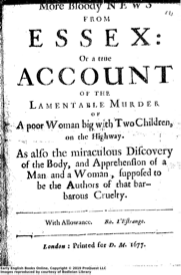
Cover page of More Bloody News from Essex. Image reproduced by ProQuest, Early English Books Online, courtesy of Bodleian Library.
But before we dismiss this piece as the primitive practice of an age that predates the standards of professional journalism, it is worth examining the coverage of crimes against women in our own society. The murders of Gabby Petito, Natalee Holloway, Laci Peterson, and Nicole Brown Simpson immediately come to mind as some of the most widely-reported cases in recent history—a list that reveals both a societal fascination with a specific type of crime and a specific type of victim. Nearly every screen in the country showed the faces of these women (and in some cases their alleged attackers) for days or even weeks as TV personalities, internet reporters, citizen journalists, and bloggers discussed the evidence and touted their own theories ad nauseum. The lack of coverage of crimes against women of color underscores the stark contrast in attention and resources dedicated to marginalized members of society.[2]
Yet while ample media coverage draws attention that can produce positive outcomes, as was the case with the internet sleuthing that helped solve Gabby Petito’s murder, sensationalizing tragedy comes at great cost. Heinous acts are often portrayed as isolated incidents rather than the culmination of escalating intimate partner violence or broader societal issues that dismiss or even promote violence against women. Headlines and soundbites designed to grab attention, sell subscriptions, and elicit clicks reduce victims to a few shocking words or phrases. As the public is inundated with sensational accounts, crimes become trivialized as entertainment, victims are dehumanized, and families are retraumatized. Constant media coverage can lend itself to a belief that everyone is entitled to intimate details of the case and the victim’s life while the curiosity of an obsessed public risks invasion of privacy and unfounded accusations. All too often, amateur investigations lead to wild speculation and victim blaming.
But, our modern fascination with true crime is not the result of the 24-hours news cycle, Court TV, or social media. We can trace the public’s fixation with macabre spectacle at least as far back as the 1830s, when low-cost printing and increased literacy rates among non-elites created a means and market for cheap, entertaining, and frequent stories that appealed to the masses. In the United Kingdom, this gave rise to penny dreadfuls, a genre of serial literature intended to entice consumers with weekly installments of their favorite stories. These short booklets popularized the consumption of horror stories, scandalous adventures, and fictionalized crimes. The more enticing the text, the more copies would be sold. Then as now, there was profitability in popular media, and a creative author with an entrepreneurial spirit needed only a touch of inspiration to make money in this ever-expanding market. Perhaps this increased exposure to indelicate topics through the lens of fiction primed the proverbial pump for the graphic, sensational reporting of true crimes that was to come.
In the United States, the real-life murder of Helen Jewett in 1836 provoked a media firestorm that divided the city of New York. Jewett was a prostitute whose gruesome murder in her bed (likely by her hatchet-wielding repeat-client and would-be lover, 19-year-old clerk Richard P. Robinson) pitted lower-class supporters of the victim against upper-class sympathizers of her alleged murderer. The cities’ newspapers drew firm lines along their readership and reported one-sided accounts of the tumultuous relationship (documented in letters between Jewett and Robinson): on one side, Jewett was the victim of a horrendous act of violence at the hands of a lover who feared exposure of his own immorality; on the other, a respectable young man was seduced by a harlot and framed for her murder as a sacrifice to appease the unwashed masses.[3]
Undoubtedly the best-known example of sensationalization of femicide is the newspaper coverage of a series of ghastly murders that occurred in London’s East End in the late-nineteenth century. Initially known as the Whitechapel Murders, at least ten women were killed in the area in 1888, although historians and Ripperologists now largely agree that only five were likely the work of the same perpetrator.[4] It was not until the press received an anonymous letter allegedly written by the perpetrator, signed by “Jack the Ripper” that the most infamous serial killer in history was given his name.
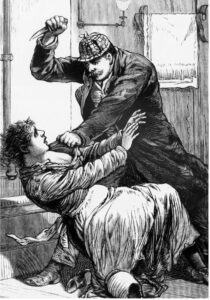
“Another Victim of Jack the Ripper – Alleged Attack on Pretty Miss Eisenhart in the Cooper Hospital, Camden, N. J., Slashing Her in a Terrible Manner”. Illustration published in the National Police Gazette (February 16, 1889).
From the outset, the London media pounced on the opportunity to regale the public with the horrific details of the brutal murders of unseemly women in London’s seediest neighborhood.[5] Newspapermen included graphic descriptions of the crime scenes and sometimes injected their reports with fictionalized details for added intrigue. Take, for example, The Eastern Evening News report of the murder of Mary Ann “Polly” Nichols, the first victim attributed to Jack the Ripper: A constable had “discovered a woman between thirty-five and forty years of age with her throat cut from ear to ear; the instrument with which the deed was done, having severed the throat from left to right. The woman was quite dead. The wound was about two inches wide, and blood was flowing profusely, in fact she was discovered to be lying in a pool of blood. The body was immediately conveyed to Whitechapel mortuary, when it was found that beside the wound in the throat, the lower part of the abdomen was completely ripped open with the bowels protruding. The wound extend [sic] nearly to the breast, and must have been effected with a large knife. The hands are bruised and bear evidence of having engaged in a struggle. Some of the front teeth have been knocked out, and the face is bruised and discoloured.”[6] Unlike today, where police try to secure crime scenes for preservation of evidence and respect for the victim, Polly Nichols’s body was on public display—if not in actuality than by the words in the press. But not unlike today, the media sought to feed the public’s insatiable thirst for details of the case. The frenzy spurred the spread of false information, dangerous scapegoating, and the misleading of police. Victims were portrayed as immoral women who paid for their sins with an unsurprising end.
The sensationalization of femicide that continues to permeate our society today is not a simple matter of insensitivity. At best, it downplays the victim’s humanity, steals her dignity, encourages victim-blaming, and promotes a narrative in which women are reduced to moral failures or helpless objects. At worst, it desensitizes the public to the most heinous crimes committed against women, normalizes abuse, and can even fuel future acts of violence among copycats and admirers.
This is not a call to downplay or dismiss acts of gender-based violence. On the contrary, we must continue to draw attention to femicide, and all crimes against ALL women. But we must ask ourselves: Where do we draw the line between sensationalism and spreading information to the broadest possible audience in hopes of engaging the general public? To begin with, instead of shaming the victims, we must blame the perpetrators. We can contextualize individual stories within broader trends so that we provide a clearer picture of the scope of the issues. And we should ask questions that bring about meaningful discourse on legal loopholes and/or institutional failures so we can begin addressing these problems.
Citations
[1] Roger L’Estrange, More Bloody News from Essex, Or, A True Account of the Lamentable Murder of a Poor Woman Big with Two Children, on the Highway as also the Miraculous Discovery of the Body, and Apprehension of a Man and a Woman, Supposed to be the Authors of that Barbarous Cruelty (London: D. M., 1677), 7. Spelling and capitalization have been modernized for readability.
[2] For more on the discrepancy in media coverage, see Kamila Kudelska, “Media Fascination with the Petitot Mystery Looks Like Racism to Some Native Americans,” NPR, September 21, 2021, https://www.npr.org/2021/09/21/1039268981/media-petito-like-racism-native-americans; Faye Shen Li Thijssen, “Intersectionality in the Face of Tragedy,” The Tufts Daily (Opinion), October 8, 2021, https://www.tuftsdaily.com/article/2021/10/intersectionality-in-the-face-of-tragedy. Organizations like the Black & Missing Foundation (https://www.blackandmissinginc.com/) and the National Indigenous Women’s Resource Center (https://www.niwrc.org/mmiwr-awareness) are working to raise awareness about the media’s under-representation of missing and murdered women of color.
[3] Patricia Cline Cohen, The Murder of Helen Jewett: The Life and Death of a Prostitute in Nineteenth-Century New York (New York: Alfred A. Knopf, 1998); Verity North, America’s First True Crime Obsession: How a Press Empire was Built on the Brutal Murder of Helen Jewett (Amazon: 2026).
[4] Alan Moss and Keith Skinner, The Scotland Yard Files: Milestones in Crime Detection (Kew: The National Archives, 2006).
[5] Judith R. Walkowitz, City of Dreadful Delight: Narratives of Sexual Danger in Late-Victorian London (Chicago: University of Chicago Press, 1992).
[6] “Another Whitechapel Tragedy. Shocking Murder of a Woman. The Crime a Mystery,” The Eastern Evening News, August 31, 1888.